Showing posts with label appalachian trail. Show all posts

Thursday, September 22, 2016

Day 12 - Downward to the Dam!

The rain I'd experienced the day before stopped overnight, but the shelter remained wrapped in a cool, heavy mist as morning crept in. I'd set my alarm for 6 AM, but overslept and found myself stowing my gear well after 7 AM.
Russell Field Shelter in the morning fog. 


With only 13.5 miles to go, and most of it downhill to Fontana Dam, I was anxious to get an early start and skipped my usual hot morning coffee for some "trail cold-brew" to go. Just add two packets of instant coffee to a liter of water, shake it up, and start walking.For some miles the fog lay heavy, but blue skies gradually broke through and it turned into a sunny day.
Shuckstack fire tower

I gradually began running into hikers starting their own GSMNP traverses. For whatever reason, more people seem to hike the Smokies starting at the south and working north. It may be because the climb out of Fontana is not as steep and rugged as the route I took to enter the park. And trail conditions in the southern half of the park were generally smoother as well. In each case, I had to pass along the bad news about the lack of water at the next few shelters. Most seem well prepared for this, but a few looked rather concerned as I passed along the info I'd gleaned while hiking south.

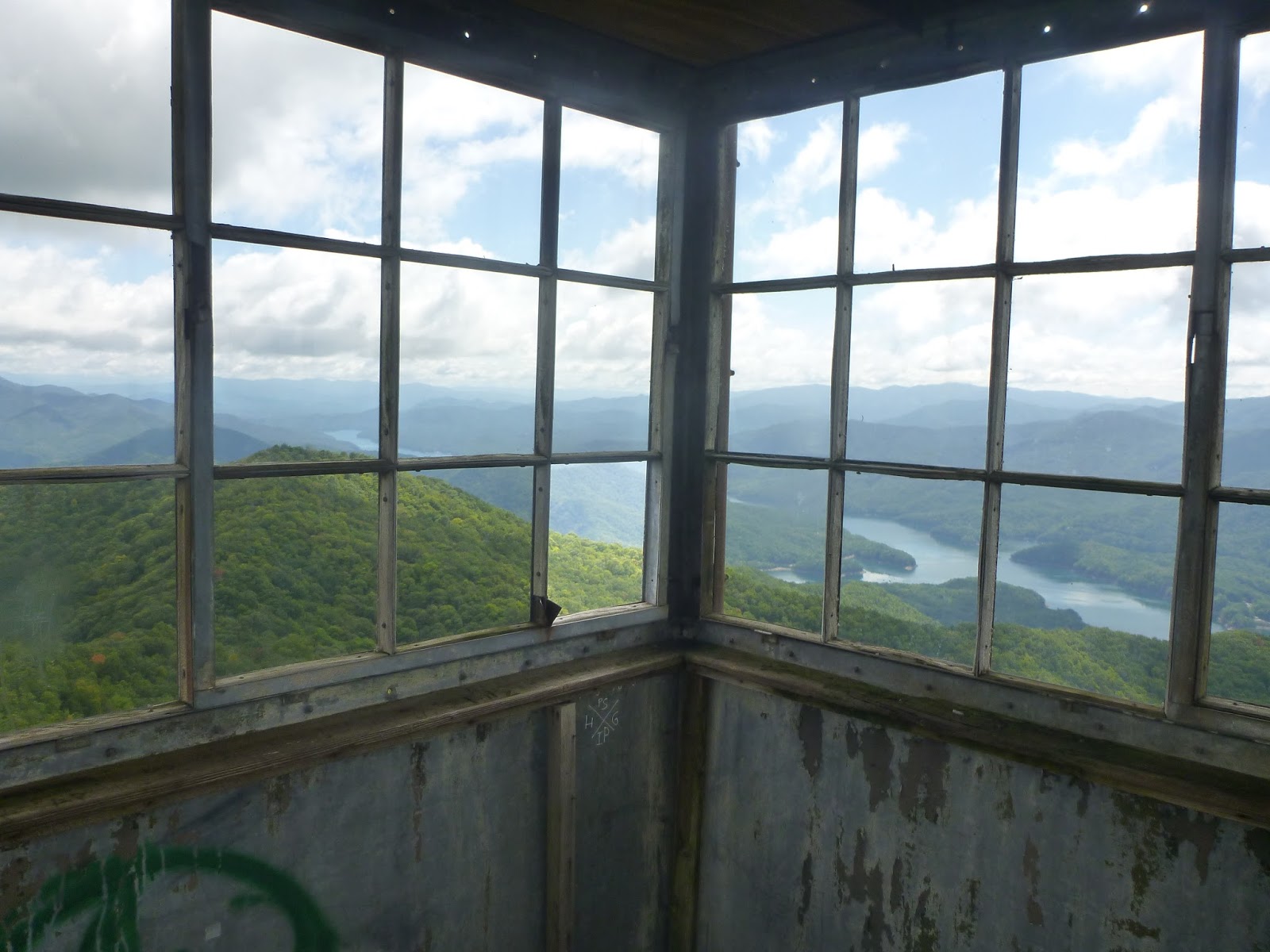
With about 4 miles to go, I took the short side trail (uphill, of course) to the Shuckstack fire tower. The tower supports only a small observation platform at the top, while the remains of the foundations of a firewarden's cabin are located below. The climb was a bit daunting, given my natural aversion to heights, but the view was excellent, and I could clearly see Fontana Lake and Fontana Dam, my ultimate destination.
It's an impressive view!


After a quick lunch break, it was time for the final push homewards, and I found myself jogging along the trail as it went down the mountain - an interesting sensation with a 30-pound  pack on your back.
Approaching Fontana Dam.

It was with real satisfaction that I strode the final yards across the top of Fontana Dam. 12 days, 175 miles, an average of 14 miles a day. Not Karl Meltzer speed, for sure, but pretty solid hiking over some big mountains and rough terrain. And best of all, nearly everything had gone according to plan. Yet I had one final surprise awaiting me.
Dead battery...
My trusty Subaru's battery was dead as a door nail. Fortunately the good people at the Fontana Dam Visitor's Center let me borrow their phone (no cell service at the dam), and I soon had AAA on the way. While waiting I talked to Samurai - the only true SOBO hiker I saw during the trip. Three months out from Maine, and with only 160 miles to go. Thin and ragged, but in good spirits.I offered a ride when my car got started, but he moved along before I was running again.
Samurai checks his trail guide
Eventually, I was on the way, with a new battery, a hot shower, and clean clothes. It was a great trip, and I'm looking forward to the future, when I can come back south to knock off the last miles between Fontana and Springer Mountain.
My white knight pickup truck.

Tuesday, September 20, 2016

Day 11 - Smoky Mountain rain

K9/18/16 - It's 8 PM - hiker midnight - and my journey has almost concluded. I have the spacious Russell Field Shelter all to myself, and overhead I can hear the intermittent patter of water dripping from the leaves onto the metal and plexiglas roof, a reminder of today's events. 

Today it rained. Except for some brief showers in the early morning hours of the fourth day, it's been dry throughout the trip. 

Hiking doesn't stop when it rains. You've simply got to gear up, put your head down, and plow ahead. As thruhikers say, "no rain, no Maine."
Morning scene - Silers Bald Shelter

Our threesome of last night grew by four after we'd turned in, as a group of four college students showed up under the guidance of their headlamps. They quickly settled in, and we all spent a fairly restful night.

By morning the wind had picked up and fog had rolled in. A sudden burst of wireless connectivity provided me with a weather forecast: a 90% chance of afternoon  thunderstorms, starting around 1-2 PM. With about 17 miles on the docket, that meant I needed to hustle.

The first 6 miles went smoothly, but then came a 6-mile stretch NOBOs had been warning about, with ascents up Thundee Miuntain and a stiff ascent over the exposed ridge of Rocky Top.

By the ascent of Thunder Mountain, the rain began in earnest, and on went my hat, rain jacket and pack cover. A steep and rocky trail made matters even more unpleasant. But as I hit the top of Thunder Miuntain, the rain eased, and I was able to traverse the exposed ridge lines with nothing worse than gusty winds and sheets of fog and mist whipping by. 

Eventually I descended to the Spence Field Shelter, the last reliable water source until Fontana Dam. I tanked up with a full four liters and made the decision to push on while the weather held.

The weather quickly turned back to sometimes heavy rain, but now I had the advantage of the best trail I'd seen in the Smokies so far - well graded, smooth, and sandy. I quickly knocked off the three miles to the next shelter and called it a day.
Gear drying time at Russell Field Shelter.

After a change of clothes and a hot mealI had time to get organized for the morning and laze away the afternoon in my sleeping bag, sipping hot tea and listening to football on my radio.

So ends another day on the trail. Tomorrow should be a fast downhill to Fontana, a shower, then the drive home to sleep in my own bed for the first time in almost two weeks. Can't wait!

Friday, September 16, 2016

Day 9 - The sublime (mostly) Smokies. And "trail talk"

I I had to put in big miles today, so I crawled out of bag shortly after our NOBO flip flop hiker broke the ice. By 6:30 I was on the trail, guided by my headlamp. 

Dawn was a treat, casting light through a wonderfully varied forest. The surrounding mountains gradually sprang into relief as the light grew and they shed layers of fog at their summits.
The Sawteeth, near Carlie's Bunion.

There's a sense of space and wildness in the Smokies that you don't find in Shenandoah. And the sheer variety of plant, animal life, and forest types is readily apparent. I saw Sarvis trees with brilliant red berries, experienced moss-covered forests, and heard bird calls that were completely outside my experience. A truly awesome place.
An all too common sight.

The bad side? The trail itself. The soil is thin on the mountain tops, and erosion often leaves the trail a mass of rocks and roots. After 20 miles, my feet and psyche had taken a beating. A hot meal helped, and fortified with that and (hopefully) a good night's sleep I'll be able settle into a few days of somewhat less mileage.
Room with a view.

So what are the main topics of conversation on the trail? 

Number 1 is, without a doubt, water. A recent dry spell has put a strain on springs, so it's courtesy for hikers passing by to share intelligence about the reliability of sources.

Number 2 is the bear situation. There were some shelter closures earlier this summer, but the trail telegraph assures me that the rangers have taken out the main problem bear, and tagged and relocated others. So all the shelters are open and everyone is breathing a little easier. 

And that's the news from the trail - you AT correspondent, signing off.

Day 8 - Stairmaster to the Smokies

9/15/16 - The first thing I check when planning the next day's hike is the elevation profile. Today's looked pretty daunting, with several long climbs and an elevation difference of almost 4000 feet. Thank goodness I was only going 11 miles.
The dim, dusty bunk room at Standing Bear Farm.

My stay at Standing Bear Farm was a mixed bag. The good - $20 for a bunk, shower, and do-it-yourself laundry, plus frozen pizzas and beer (I'll have two pints of Fat Tire, please). The bad - a distinct lack of any basic housekeeping skills. Rustic is cool, but would it hurt to pick up a broom?
Carl, the go-to guy at Standing Bear (he has the key to the beer).

Despite that, I had a relaxing stay and left clean and resupplied, thanks to my mail drop. Soon I dropped my permit in the box and started up.
I'm official!

What was left was a hot, steep climb, made worse by a miscalculation that left me short of water over the last few miles. But all finished well, and I was the first into my shelter for the night. 
The view from my bunk.

Business picked up, and we've got 9 in the shelter, including a young lady who'll finish her flip-flop in Rockfish Gap. 

Shooting for 20 tomorrow, so it's just about bed time for me!


Thursday, September 15, 2016

Day 6 - Karl and Max

Karl Meltzer (in yellow) leaves me in his dust while attempting an AT fastest time.

I'd been on the trail for about 90 minutes when I suddenly heard footsteps behind me. "Karl?" I asked. "Yes" he said. I congratulated him, wished him well, and he even obliged for a photo. Class act.

He trotted away, but I soon caught him at the nearby road crossing, where his crew was set up. After he departed, they offered up food and drink to me, and chatted about my trip. Kind of cool to have Scott Jurek (the current record holder) shooting the breeze and wishing you well on your trip. 
Historically significant trail magic.

Now back to the business at hand, the 2000 foot ascent up Bluff Mt. I paused for my crew-supplied Coke and PBJ and tackled the ascent with no problem. No doubt, I'm feeling stronger and covering miles more easily each day. The rest of the day went smoothly, and I was even moving well enough to take a leisurely one hour lunch break. 

After 15 miles Instopped for dinner at a shelter and shot the breeze with a duo from Key West. No doubt, they should have cast these two in the film version of "A Walk in the Woods." They're struggling south from Damascus at a painful 5-8 miles a day, while continuing to carry all the important essentials, like a fold-up saw and wind-up radio.
Summit view - Max Patch

Now the second highlight of the day - Max Patch. It's a grassy bald with 360- views, and one of the must-see spots on the trail. The perfect trifecta is to camp on the bald, so you can watch the sunset, stargaze, and then catch the dawn. Sunset down, two more to go!


Monday, September 12, 2016

Special - Elmer's Sunnybank Inn


The oldest home in Hot Springs, circa 1840.

In 1948 the first AT thruhiker, Earl Shaffer, spent the night at a rooming house in Hot Springs. Since then, under one name or another, Sunnybank has hosted weary hikers.
Some Sunnybank history.

It's current owner, Elmer, has run Sunnybank since 1978. While the home still maintains much of its Victorian charm, it also shows its age as well. But the upside is found in the low-key comfort and eclectic atmosphere. You can easily imagine grabbing a book from the large library and dozing off on one of the many shady porches.
View from the back yard.

I'll talk a little more about Elmer and Sunnybank in my next post. For now I'll share some pictures.

Thursday, September 08, 2016

Day 1 - Head for the mountains

There are a few reasons the first day of an AT backpacking trip is one of the most challenging. Your pack is loaded with food. The specific conditioning of hiking with the pack is lacking. And finally, AT trailheads are at the low points of the trail. 
Starting my hike - Erwin, TN. Elevation 1770'

Case in point - Erwin, TN is nestled in the Nolichucky River valley, at 1770 feet above sea level. Right off the bat you're looking at a 1500' climb.

And so the course of the day was set. As the trail wound south from Erwin the sounds of town and highway faded away, replaced by the sound of my steps and the rustling of leaves in rhododendron-filled secluded coves. 

Always, though, was the realization that I was moving further into, and further up, the mountains. The last six miles presented two stiff 1000'+ climbs, accompanied by rough trail conditions. So it was a relief to see the side trail to the shelter and have a chance to clean up, fix dinner, and regroup for tomorrow's hike.
Bald Mt Shelter - 5100'

It's been quiet on the trail so far, with only a handful of northbound section hikers, so it looks like I've got the shelter all to myself.

Total time on trail - 9:15
Total distance. - 16.8 miles
Avg speed - 1.8 mph

Wednesday, September 07, 2016

There and (partly) back again

One of the challenges of section hiking is transportation. When I was backpacking in VA, it didn't require a long drive to drop off a vehicle and get to the trailhead. Now that I'm in NC and TN, it's a little harder.
Fontana Lake, with the Smokies in the background.

The day started with a 7-1/2 hour drive to the Fontana Dam visitor center, where I parked (and locked) my car and met my shuttle driver.
Ronnie, my shuttle driver.

Now it was time to backtrack for two hours, to where I'll pick up the trail in the morning. 
Mountain Inn in Erwin, TN - my home for the night.

So, after a long day in the car, I'm comfortably settled in at my motel with a couple of beers and a delivery pizza. Plus the Tour of Spain is on the TV. Reality check tomorrow, as I tackle my first climbs and hope for a solid 16-mile day.


Saturday, September 12, 2015

Packing Up - Part 1


From chaos, order


I leave on Thursday, so it's getting towards crunch time. Time for final packing and logistics. My shuttle is confirmed, so now it's up to me to be ready to go. 

And for a bit of practice, I'm writing this with my iPhone and the Blogger app, the same way I'll journal from the trail.

The first stages of packing up is a bit daunting. Rubbermaid boxes of gear are emptied, piling up into a disorganized mess on the family room pool table.

Although it looks bad, experience has taught me that if I start working my way through each of the big categories (food, sleep, cooking, hydration, etc.) things come together pretty quickly.

Food
I've got two missions here - prep a mail drop and pack my first few days supply.

The mail drop contains supplies I'll need for the second portion of the journey, and I'll ship it off to the hostel on Monday. That'll give it a week to get there via UPS.


Next is my starting supply - this is placed in a waterproof stuff sack that I can hang from a tree or bear pole when I'm in camp. In addition to food, I keep my toothpaste/brush and the bear bag rope (50' of paracord) in the bag. That way I don't have to search for it in my pack.

Unpacked 

In the stuff sack

Next time: Sleep and Shelter


Monday, August 31, 2015

Trail Food -- What's for Dinner?

Tonight's entree...

Stories are told of potential Appalachian Trail backpackers carrying packs burdened with massive amounts of food, convinced that they'd have no chance to resupply for hundreds of miles as they traversed the wilderness. But as I pointed out in my last post, it's unusual to go more than 4-5 days on the AT without some opportunity for resupply. A 4-5 day supply is still a pretty fair amount of food, so the hiker must make some smart decisions on what to carry.
Cooking dinner - near Pearisburg, VA, 2011.
The first rule is to forget about carrying fresh fruits and vegetables -- they're just too heavy, and they don't travel well. Sure, you can toss an apple or an orange into your pack for the first day or so, but after that you're out of luck, unless you happen to come across an abandoned orchard in the mountains (I have, and the apples were delicious!)
Snacking on apples - Greasy Creek Gap, TN, 2014.
Canned foods are definitely out -- way too heavy and bulky. Exceptions could once be made for items like canned tuna, but you can get that in foil-lined pouches now. One exception that's still valid? Canned beer -- tasty when cooled in a mountain spring or stream, and the aluminum cans are easy to pack out. Unfortunately that's a pretty rare treat, since nobody wants to carry a six-pack for days on end. But if you're hiking through Shanandoah National Park, the campstores and waysides offer plenty of resupply options.

Some hikers will pack freeze-dried backpacking meals, but they tend to be expensive and are usually only carried by weekenders and other short-timers. That leaves dry goods and foods that travel well as the staples of backpacking. Everyone's different, but here's a typical menu for a day on the trail:

Breakfast: Instant coffee (Starbucks Via is the best); protein bar or pop-tarts. In cooler weather I'll sometimes take instant oatmeal so I can start the day off with a hot meal.

Lunch: Tortillas with pepperoni and cheddar cheese. The cheese and pepperoni stay good for a surprisingly long time, even in warm weather.
Lunch. VA, 2011.

Dinner: Couscous with tuna or sausage. Couscous is one of my favorites -- you can buy it in bulk; it cooks with very little fuel, and it's light. I'll mix in some olive oil, dried vegetables, and spices to liven it up. Other go-to dinners are instant mashed potatoes, or Lipton noodles or rice side dishes -- one pouch equals one serving for a hungry hiker.

During the day I'll snack on energy bars or Snickers, and I'll often mix my water with drink mixes, like lemonade or sports drink powders. It adds some variety and keeps the calorie count up.

Restocking your provisions

If you're carrying food for 4 days, but planning to hike for 7-10, you've got to resupply. If my route goes through a town with a well-equipped grocery store, it's easy enough to stop in there for the goods I need. But more often I've relied on mail drops to get the supplies I need.

Mail drops are an old AT tradition. In the purest form, a hiker mails a box of supplies ahead to the local Post Office, addressed to themselves at General Delivery. Stop by during business hours, show some I.D., and you've got your package. Thru-hikers often utilize mail drops for more than just food. They'll send along extra clothing, spare parts, batteries, phone chargers, and even laptops from town to town, using what's called a 'bounce box." It eliminates the need to carry extra gear they may not need on the trail.

Lodgings along the AT usually accept mail drops, so I can kill two birds with one stone by having a supply of food and other essentials waiting for me at my planned town stops. For this trip I'll start light, and resupply on the third night, when I stay at the Ironmaster's Mansion Hostel.

Most AT hostels and other lodgings will hold mail drops for guests, or for a fee, if you're not a guest. Tennessee, 2014.

 Next time - What to wear.

Thursday, August 27, 2015

Town Stop -- Trail Towns and Lodging

Town stops

When Earl Shaffer completed the first thru-hike of the AT in 1948 he spent only one night off the trail. Making that feat even more impressive is the fact that he didn't have a tent, and shelters were few and far between. Then again, Earl, didn't mind sleeping on the ground, wrapped up in an army surplus poncho and sheltering under a fallen tree.

I'm not so tough.
A real bed, a shower, TV, and a Subway next door! Near Atkins, VA, 2013.

On my longer trips I've found that getting off the trail every 4th night or so is a welcome break. It gives me a chance to take a shower, wash your clothes, and sit down and eat a meal that isn't in a 1.5-liter titanium pot.

But where to stay? Fortunately you're never really that far from a town on the AT. Even with a modest pace, you're likely to encounter an opportunity to make a town stop every 4-5 days -- or even more often in heavily populated areas like the mid-Atlantic.

Sometimes the trail leads directly into town, and lodging options, meals, and other services are in easy walking distance. In other areas you may need to hitch a few miles or call for a ride to get into town. The trail cuts right through towns like Hot Springs, NC and Damascus, VA, and they're very popular stops with AT hikers.
Hiking into Damascus, VA, 2014.
As a section hiker, I'm on a tight schedule, so town stops are worked into my schedule and only involve an overnight stay -- I've never taken a "zero day" (when you don't hike at all, but stay in town to rest and catch up on laundry, shopping, etc.). For some potential thru-hikers, the siren song of town days is their undoing -- they spend too much time off the trail and run out of time and money to finish their hike.

Lodging

When you're tired of sleeping in the woods, you've got options. In larger towns and near many road intersections there are motels, both local and chains. Many offer reduced hiker rates, and they're often near other services, like restaurants and stores. Motels have the advantage of privacy and a higher level of amenities, like endless hot showers, TV, and a free continental breakfast. I fondly remember hunkering down on a comfy bed with a pile of junk food in Atkins, VA, watching the "Indiana Jones" trilogy on TV, recovering from 5 days of hiking while washing/drying my gear and recharging for the next section. And in the morning I demolished the breakfast, plus packed enough for my lunch...

Likewise, some hikers choose a local Bed and Breakfast for their stay off the trail. Generally that's a somewhat more pricey option, though some B and B's in trail towns offer special rates for hikers.

A more genuine "trail experience" is to stay at a hiker hostel. Hostels can be hard to classify, since there's no real standard as to what a hostel is, or what it offers. Expect bunk rooms, shared bath rooms, and common areas which may include kitchen and laundry privileges, and varying levels of housekeeping. But you can always count on them to be cheaper than a motel -- I've spent as little as $5 (suggested donation), or as much as $30 for a "Hiker's Special" -- bunk, shower, towel, a frozen pizza, a pint of Ben and Jerry's, and a Coke. Money well spent in the latter case.

On the high end, there are hostels like Bears Den in northern Virginia. Run by the Potomac Appalachian Trail Club (PATC), Bear's Den is a beautiful old stone vacation home, converted into accommodations for hikers.
Bears Den Hostel, 2010 -- every bit as nice as it looks!
Bear's Den offers attentive caretakers, clean and comfortable lodging, and elegant common areas with an excellent library. I spent a very pleasant evening there in 2010, chilling out and reading a copy of Aldo Leopold's "A Sand County Almanac." You don't get a much better experience than that.

One the other end of the spectrum you'll find a variety of establishments of varying quality and very different vibes. These can range from a legendary trail stop in Tennessee that's an absolute dump (no names mentioned), to Woods Hole Hostel, a working organic farm (amazing food and company!) There are plenty of AT forums where you can get the skinny on hostels and other lodging options. A good place to start is this list at whiteblaze.net -- investigate the forums for other hiker's experiences to see if your lodging choice is a good fit for you.
Hikers relaxing on the porch at Woods Hole Hostel, 2013.

Next time - Food and resupply

Monday, August 24, 2015

Gimme Shelter

Be it ever so humble...

One of the most interesting aspects of hiking the AT is the shelter system. There are approximately 300 shelters along the length of the Trail, all intended for use by hikers, both long- and short-term. While the size and design of shelters varies, most are simple wooden structures, enclosed on three sides, with a sleeping platform that'll accommodate about six people. Hike in, roll out your pad and bag, and make yourself at home.
 
Taking a break at a typical AT shelter (the Tom Floyd Wayside, 2010).
Shelters are popular destinations. There's usually a reliable water source, a roof over your head and the company of your fellow hikers to socialize with. But one major downside of shelters is also the company of your fellow hikers. Simply put, it's sometimes hard to get a good night's sleep when you're listening to your bunkmates snore (and it cuts both ways, since I'm a snorer...). Not to mention, many AT shelters are infested with mice (and worse). The pitter-patter of tiny feet running around your bag and the gnawing of tiny teeth burrowing into your gear doesn't always make for prime sleeping. Still, a dry shelter with good company can be a cozy place during a rainy night on the trail.
Staking my claim at Hurricane Mountain Shelter, 2013.

 Tenting tonight...

It's not wise to count on shelters for your nightly accommodations. While plentiful, shelters aren't always evenly spaced, so you may find yourself having to go further or fewer miles than you'd planned if you're committed to staying in one. And there's no guarantee there's going to be space when you get there. That's why most hikers carry a tent, tarp, or hammock with them.
My tent (a Henry Shire TarpTent Moment) drying out after a couple of wet days in 2013.
A tent offers privacy and a little more peace and quiet than you'll find in a shelter, but there are downsides. Packing up a wet tent after a rainy night isn't a lot of fun. And finding a good, level tent site isn't always easy. Plus, sleeping by yourself in the woods can take a little getting used to. Even a squirrel rummaging around in leaves brings visions of a T Rex invading your camp until you get used to it. Still, all things considered, a good tent site on a pleasant night is hard to beat.
Morning coffee in the tent, near Mt. Rogers, VA, 2013.

 Next time -- Hostels, motels, and resupply.